


[Announcement] Signs Health Policy Recommendations to the G7 by the C7 Global Health Working Group (March 30, 2026)
date : 5/1/2026

![[Announcement] Signs Health Policy Recommendations to the G7 by the C7 Global Health Working Group (March 30, 2026)](https://hgpi.org/en/wp-content/uploads/sites/2/HGPI_20260403_C7GHWG-1.png)
Health and Global Policy Institute (HGPI) has signed the health policy recommendations for the G7 compiled by the Civil 7 (C7) Global Health Working Group, titled “Achieving Global Health Equity: A C7 Call to Solidarity, Resilience and Inclusion.”
C7 is one of the official engagement groups that provides policy recommendations to the G7. It serves as a platform that brings together the voices of civil society organizations from G7 countries and beyond, and communicates recommendations to G7 Summits and relevant ministerial meetings. While health is essential for global stability, economic prosperity, and the achievement of the Sustainable Development Goals (SDGs), ensuring sufficient prioritization of health within the G7 has become an ongoing challenge in recent years.
Against this backdrop, under the 2026 C7 Presidency of France, the Global Health Working Group was established to reposition health as a cross-cutting priority across multiple policy areas. This set of recommendations was developed in response to these challenges and is intended to inform G7 discussions on global health.
The recommendations highlight ongoing concerns about persistent health inequities and increasing pressure on health financing systems. They also underscore that the “Triple Planetary Crisis” , is exacerbating threats to health. In response, the recommendations call for the strengthening of resilient and equitable health systems, including enhanced efforts in Pandemic Prevention, Preparedness and Response (PPPR).
■ Key Recommendations
The recommendations are structured around the following three pillars:
- Advancing Universal Health Coverage (UHC) That Leaves No One Behind
- Deliver comprehensive health services across the life course, including prevention, treatment, rehabilitation, and palliative care, with primary health care as the foundation.
- Integrate key areas such as nutrition, non-communicable diseases (NCDs), mental health, and sexual and reproductive health and rights (SRHR) into health systems.
- Ensure equitable access to medicines, vaccines, and diagnostic technologies, and institutionalize the participation of civil society and affected communities in health decision-making processes.
- Strengthening Health Financing
- Position health expenditure not as a short-term cost, but as a long-term investment in human capital, economic stability, and sustainable development.
- Expand Official Development Assistance (ODA) and enable countries to secure fiscal space for health through measures such as tax reforms and subsidy restructuring.
- Reform the global health financing architecture to better align with national priorities, while strengthening sustainable and flexible financing for the World Health Organization (WHO).
- Promoting a One Health Approach
- Address the “Triple Planetary Crisis”—climate change, biodiversity loss, and pollution—by taking an integrated approach to climate, environment, and health.
- Accelerate the transition to climate-resilient and low-carbon health and food systems, including the decarbonization of health systems and supply chains.
- Build resilient and sustainable health systems through biodiversity conservation and restoration, as well as strengthened Pandemic Prevention, Preparedness and Response (PPPR).
Several key global health perspectives proposed by HGPI are reflected in these recommendations. Notable contributions include the explicit recognition of the “Triple Planetary Crisis,” the promotion of decarbonization in health systems and supply chains, and the advancement of a circular economy aimed at reducing healthcare waste. The recommendations also incorporate the concept of biodiversity “restoration,” in addition to conservation. Furthermore, the document highlights the importance of strengthening collaboration between ministries of finance and health. It also recognizes rapid population aging in low- and middle-income countries as a critical challenge for achieving UHC.
HGPI will continue to contribute to addressing global health challenges and to advancing sustainable and inclusive health systems, through active participation in international policy dialogues, including C7, and through collaboration with global partners.
*The full text of the recommendations is available in the PDF below.
![[Recommendations] Achieving Global Health Equity: A C7 Call to Solidarity, Resilience and Inclusion](/assets/img/katsudo/icon_pdf_l.png)
Related Posts
-
2023-04-20
[Policy Recommendations] Recommendations for the G7 Hiroshima Summit by the C7 Global Health Working Group (April 20, 2023)
-
2026-04-20
[Announcement] HGPI Endorses the UHC2030 Global Compact for Progress Towards Universal Health Coverage (March 31, 2026)
-
2025-12-11
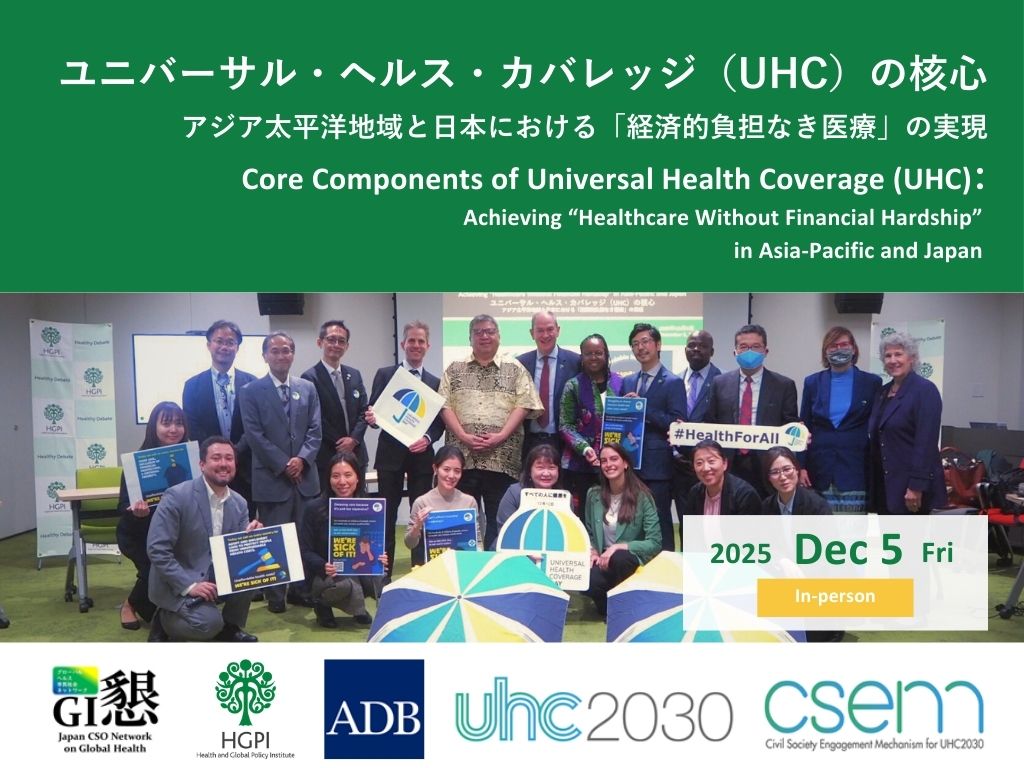
[Event Report] Core Components of Universal Health Coverage (UHC): Achieving “Healthcare Without Financial Hardship” in Asia-Pacific and Japan (December 5, 2025)
-
2025-04-23
[HGPI Policy Column] (No.58) — From the Global Health Strategy Project — “Toward Fair Health Systems: The Power of Data in Advancing UHC and Supporting Health Financing”
Top Research & Recommendations Posts
- [Research Report] Energy Conservation and Greenhouse Gas Emissions Reduction in Healthcare Facilities: Case Studies from New Construction and Facility Renewal (March 16, 2026)
- [Research Report] Perceptions, Knowledge, Actions and Perspectives of Healthcare Organizations in Japan in Relation to Climate Change and Health: A Cross-Sectional Study (November 13, 2025)
- [Public Comment Submission] “The 7th Science, Technology and Innovation Basic Plan” (Draft) (February 19, 2026)
- [Research Report] The 2026 Public Opinion Survey on Healthcare in Japan (February 13, 2026)
- [Policy Recommendations] Policy Recommendations in the Field of Blood Disorders “Building a Healthcare Ecosystem Centered on Patients and Those Affected” (April 13, 2026)
- [Research Report] The 2025 Public Opinion Survey on Healthcare in Japan (March 17, 2025)
- [Public Comment Submission] R&D and Social Implementation Plan for “Achieving Carbon Neutrality in the Waste and Resource Circulation” under the Green Innovation Fund Projects (Draft Revision) (March 25, 2026)
- [Policy Recommendations] Developing a National Health and Climate Strategy for Japan (June 26, 2024)
- [Policy Recommendations] Mental Health Project: Recommendations on Three Issues in the Area of Mental Health (July 4, 2025)
- [Research Report] AMR Policy Update #2: WHO’s First Report on Fungal Infection—Bridging the Gap Between Clinical Practice and R&D
![[Research Report] The 2026 Public Opinion Survey on Healthcare in Japan (February 13, 2026)](https://hgpi.org/en/wp-content/uploads/sites/2/HGPI_The2026PublicOpinionSurveyOnHealthcareInJapan_20260213.jpg)
![[Publication Report] Future of the Healthcare System Project “Policy roadmaps for acting early on NCDs” (March, 2026)](https://hgpi.org/en/wp-content/uploads/sites/2/HGPI_PHSSR-Report_20260421.png)
